The Quiet Angle: Reading Sleeve Pitch in a Tailored Jacket
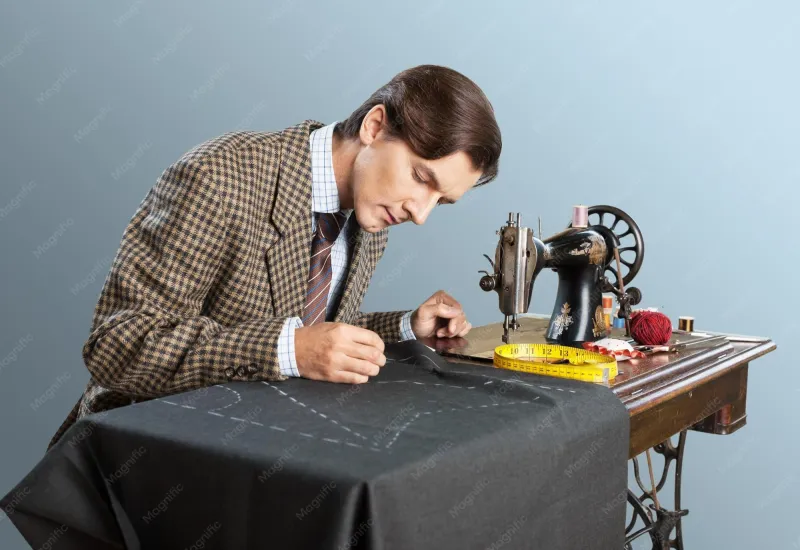
Photo: tailor fitting jacket sleeve armhole close up neutral atelier, via img.freepik.com
Few details in a tailored jacket announce themselves less and matter more than the angle at which the sleeve is joined to the body. Tailors call it pitch: the forward or backward inclination of the sleeve as it is set into the armhole. It is not a measurement one finds on a label, nor a feature a salesperson is likely to name. Yet pitch quietly determines whether a jacket hangs cleanly from the shoulder, whether the arm can move without dragging the chest, and whether the garment feels at ease after an hour or merely tolerable for a minute.
In a well-pitched sleeve, the cloth follows the body’s natural stance. The arm does not hang perfectly vertical from the shoulder; it falls slightly forward, with the elbow relaxed and the wrist resting ahead of the hip. A sleeve set with this anatomy in mind will appear calm from the front, clean from the back, and free of diagonal strain when the wearer reaches for a cup or hails a cab. A sleeve set at the wrong angle may look almost correct on a hanger and reveal its faults only in motion.
What Pitch Actually Is
Pitch is distinct from sleeve length, cuff width, or the shape of the sleevehead. It concerns rotation—how the tube of the sleeve is turned as it meets the armhole. Think of the sleeve as having a front and a back, an inside and an outside. If that tube is rotated too far backward, the front of the armhole begins to bite into the chest and the sleeve may twist toward the body. If it is rotated too far forward, excess cloth gathers at the back of the armhole and the wearer feels restricted when reaching forward.
The correct pitch is not a universal number. It reflects posture, shoulder slope, the prominence of the shoulder blade, and the way a person habitually carries the arm. This is why two jackets of identical size can feel entirely different on the same body. The difference may not be visible at a glance; it lives in the angle of a seam and the behavior of cloth under motion.
Why Ready-to-Wear Often Misses
Most off-the-rack jackets are cut on an average block, and averages are useful only until they meet a real body. A coat designed for a neutral stance may sit slightly wrong on a wearer whose shoulders roll forward, whose chest is fuller, or whose arms rest farther back than the pattern assumes. The result is often subtle: a small fold beneath the armhole, a sleeve that seems to drift inward at the wrist, or a faint diagonal crease across the upper back when the arm extends.
These signals are easy to misread. A shopper may blame sleeve length, shoulder width, or the garment’s overall cut when the true culprit is pitch. In a department store fitting room, under flat light, the problem can be nearly invisible. In daily life—reaching across a table, driving, carrying a bag—it becomes persistent. The jacket is not necessarily poorly made. It is simply angled for a different body.
The Fitting Room Test
Testing pitch requires movement, not just a mirror. Put the jacket on over the shirt or knitwear with which it will most often be worn, and stand naturally rather than adopting a rigid pose. Let the arms hang. Look at the front of the sleeve: it should fall with a gentle, unforced curve and should not appear to twist around the arm. Check the back of the armhole for surplus folds or a hollow that suggests the sleeve is pulling away from the body.
Then move. Reach forward as if to shake hands, lift the arms slightly, and cross the forearms. A well-pitched sleeve permits these gestures without hauling the jacket’s chest out of place or creating a deep crease at the front of the armhole. Ask someone to observe from the side. The sleeve should follow the arm’s natural forward inclination rather than hanging like a plumb line.
Finally, inspect the elbow area. Horizontal wrinkles are expected when the arm bends; diagonal wrinkles radiating from the armhole are more telling. If the jacket feels as though it is correcting your posture, pitch is one of the first details to question.
What a Tailor Can—and Cannot—Do
A skilled alterations tailor can sometimes rotate a sleeve to improve pitch, but the procedure is not universal. The seam allowance at the armhole must be sufficient, the sleevehead must allow for adjustment, and the fabric must tolerate being reopened and resewn without losing its line. On a lightly constructed jacket with generous inlays, the correction can be remarkably effective. On a closely trimmed garment with narrow allowances or delicate cloth, the risk may outweigh the reward.
The alteration is also not a matter of simply twisting the sleeve until it feels better. The tailor must preserve the balance of the jacket: the relationship between collar, shoulder, chest, and armhole. A correction that eases the arm but disturbs the front edge or the shoulder line is not a success. This is why the work belongs to someone who understands tailoring rather than merely sewing, and why a preliminary conversation matters as much as the alteration itself.
A Small Angle, a Different Life
Sleeve pitch is a reminder that tailored clothing is judged not only by what is visible but by how it behaves. A jacket can pass the mirror test and fail the test of an ordinary day. The quiet angle where sleeve meets shoulder is one of the clearest expressions of a maker’s understanding—and of a wearer’s need to look past the surface. In the fitting room, give the sleeve time to reveal itself. The reward is not a dramatic transformation but something more lasting: a jacket that moves as though it were always meant to be yours.