The Standing Question: What a Shirt’s Collar Band Reveals About Its Making
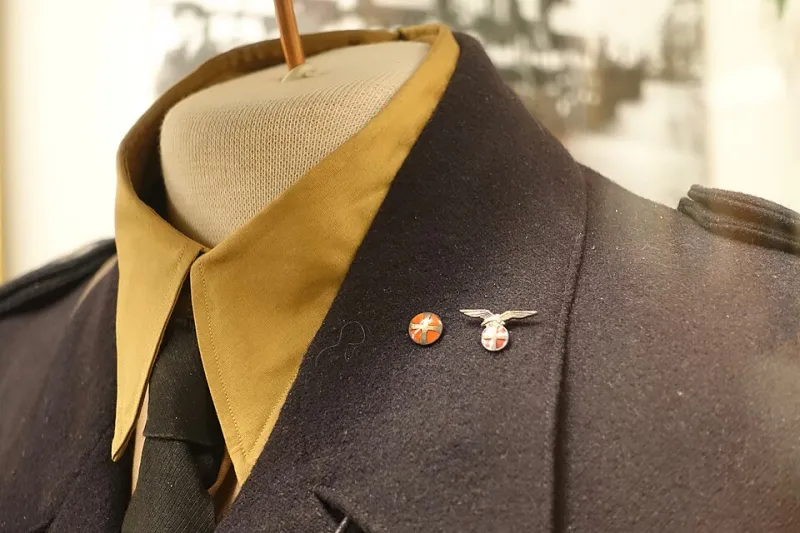
Photo: Wolfmann, CC BY-SA 4.0, via Wikimedia Commons
A shirt collar is usually discussed in terms of its points: spread, button-down, cutaway, club. Yet the more consequential element sits beneath that visible leaf, a narrow band encircling the neck that most shoppers never examine. The collar stand—sometimes called the collar band—is the foundation on which the entire neckline rests. It is rarely more than two inches deep, but within those inches a maker decides how a shirt will stand, roll, and endure. In 2026, as American wardrobes lean toward fewer, better shirts, the band deserves the same scrutiny we give a jacket’s shoulder or a trouser’s rise.
The Band Before the Point
The collar stand is not decorative. It is structural. It holds the collar leaf upright at the back of the neck, creates the line that meets a jacket lapel, and determines whether a tie knot sits with ease or strain. A stand that is too shallow can let the collar leaf collapse; one that is too tall can press against the throat or push a jacket collar away at the back. The right height is not a universal number but a relationship—between the wearer’s neck length, the shirt’s intended use, and the maker’s pattern.
In a formal shirt, the stand is often taller and firmer, designed to support a tie and frame the face with composure. In a casual shirt, it may be shorter and softer, meant to lie open with a relaxed roll. Neither is inherently superior. The question is whether the stand has been considered, or merely attached.
Height, Roll, and the Geometry of the Face
Stand height is measured from the seam where it joins the shirt body to its upper edge. A taller band tends to create a more upright, formal line; a shorter band reads easier and less constructed. But height alone tells only part of the story. The roll—how the collar leaf falls forward from the stand—is equally decisive. A graceful roll begins at the stand’s top edge and continues through the leaf without a hard break. When the roll is poorly set, the collar can look stiff at the neck and flat at the points, as if two separate parts were joined without conversation.
In the fitting room, button the collar and look straight into a mirror. The band should sit cleanly around the neck without gaping at the back or pinching at the front. Turn your head slowly left and right. A well-set stand follows the neck with mild resistance, not rigidity. If the band digs in at the throat or stands away at the nape, the pattern or the interlining is likely working against you.
What the Fingers Learn
Before mirrors, use your hands. Run a thumb and forefinger along the inside of the stand. It should feel firm enough to hold its shape but not board-stiff. A good band has a subtle give—an elasticity that suggests cloth and interlining are moving together rather than fighting. Pinch the stand between finger and thumb at its center front. If it feels uniformly hard, like a folded card, the interlining is likely fused across the whole surface. If it feels slightly soft in the middle and firmer at the edges, the interlining may be floating or spot-fused, allowing the collar to curve more naturally.
Look closely at the attachment. The stand is usually joined to the shirt body with a seam that sits at the base of the neck. On a well-made shirt, that seam is clean and flat, with no puckering or twisting. The top edge of the stand—where it meets the collar leaf—should be turned and stitched with even tension. A wavy top edge or a row of uneven stitches is a small warning: if this visible junction is careless, the hidden construction may be too.
Fused, Floating, and the Question of Time
Much of the stand’s character comes from its interlining, the stiffening cloth inserted between its layers. Fused interlining is bonded to the fabric with adhesive; it is efficient and can produce a crisp, consistent band. But over time and repeated cleaning, fusing can bubble, delaminate, or stiffen in ways that feel unnatural at the neck. Floating interlining—cut slightly smaller and secured only at the edges—allows the collar to move more freely and to develop a personal roll. It is slower to make and often found in shirts from independent makers who treat the collar as a piece of tailoring rather than a trim.
Neither method is automatically good or bad. A well-executed fused stand can serve a crisp dress shirt admirably. The problem is not fusion itself but fusion used to disguise a lack of shaping. A maker who understands the band will shape the interlining, grade the seam allowances, and press the stand into a curve that follows the neck. That curve is the difference between a collar that sits and a collar that clamps.
A Fitting-Room Protocol
When judging a shirt, bring a jacket if you intend to wear one with it. The collar stand must coexist with the jacket collar; a tall, stiff band can push the jacket away at the back, while a flimsy one can disappear beneath it. Button the shirt to the top and check the space between the band and your neck—enough to slip a finger, not enough to lose one. Then unbutton it and see how the stand behaves. A good band relaxes without collapsing.
If you wear a tie, knot one in the shop. The stand should support the knot without forcing it forward. If you do not wear ties, pay attention to how the open collar frames your face. The stand should provide a quiet frame, not a visible scaffold. Finally, look at the shirt from the side. The band should meet the neck at a gentle angle, neither sawing into the throat nor floating away at the nape.
The Maker’s Signature
Independent shirtmakers often speak of the collar stand as a signature because it is difficult to fake. It requires curved pattern pieces, careful interlining, and a press that understands the three-dimensional neck. It is also one of the first places a cost-cutting manufacturer will simplify. A stand that has been shaped, not just sewn, tells you something about the maker’s priorities. It suggests a shirt designed to be worn, not merely sold.
In a wardrobe built on considered choices, the collar stand is a small test with a long result. It decides whether a shirt greets the face with ease or friction, whether it slips under a jacket with grace, and whether it still looks composed after a hundred wearings. Two inches, more or less, are enough to reveal the hand behind the cloth.